Changes to Immigration Levels, Policies, and Settlement Services
Immigration Landscape
Hamilton’s present and future continue to be shaped by immigration. Close to three in 10 Hamiltonians were born outside Canada. Immigrants play a key role in growing Hamilton’s population, contributing to the local economy, and enriching the social and cultural fabric of the city.
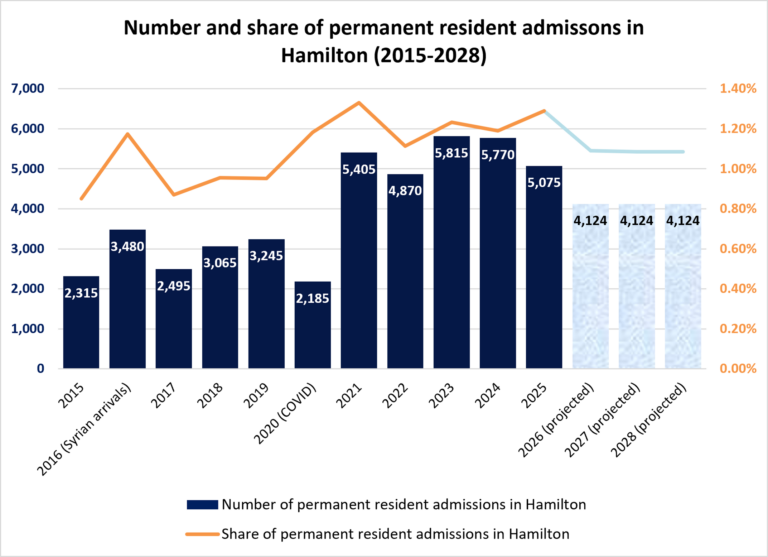
From 2021-2025, Hamilton welcomed more than 5,000 new permanent residents annually (averaging 5,553 per year between 2023 and 2025). Under the federal changes, Hamilton’s average annual permanent resident intake is projected to drop by 26% to roughly 4,124 in 2026 compared to 2025.
Immigration Levels Plan
Every year, Immigration, Refugees and Citizenship Canada (IRCC) announces immigration levels plans which set annual targets for permanent residents and, more recently, temporary residents. In 2025, for the first time in recent history, IRCC reversed course and reduced its immigration targets.The 2026–2028 immigration levels plan represented a continued trend with decreases to temporary resident and permanent resident admissions:
Permanent Resident Target
Temporary Resident Target
IRCC’s new immigration levels plan for 2027-2029 is expected to be announced in November 2026.
Changes in Settlement Services
In 2025, the federal government announced a Comprehensive Expenditure Review (CER) focused on lowering federal spending to pre-pandemic levels. As part of CER, IRCC needs to meet a savings target of 15% over three years, in addition to any decreases brought about by lowered immigration target. These cost-saving measures have so far resulted in staff layoffs, program closures, and service disruptions in the settlement sector and are expected to continue in the coming years (IRCC, 2026).
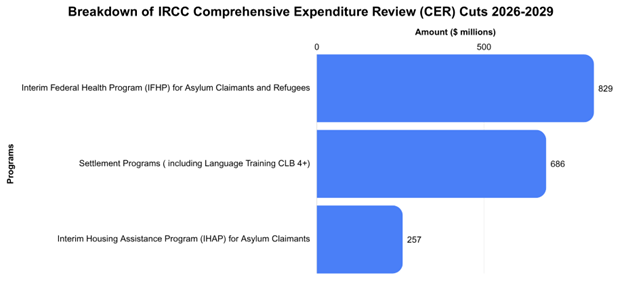
These cost-saving measures are targeting three main areas in the immigration system:
- Refugee and Asylum Claimant Health Care or the Interim Federal Health Program (IFHP)
- Settlement Programs (including language training and immigration partnerships)
- Interim Housing Assistance Program (IHAP) for Asylum Claimants
Changes in the IFHP represent the biggest cut in IRCC budget. The IFHP provides temporary healthcare coverage to refugees, asylum claimants, and other vulnerable populations in Canada until they are eligible for provincial/territorial health insurance (IRCC, 2026). It supports basic health coverage for refugees and asylum seekers by covering critical medications, dental care, mental health counselling, vision care, and physiotherapy.
As of May 2026, asylum seekers and refugee claimants are required:
- to pay 30 percent of preventive services like dental care; and
- a $4 co-payment fee for prescription drugs (IRCC, 2026).
Changes in the federally-funded settlement services represent the second largest cut, predominantly through the elimination of the advanced language training classes. Settlement services are delivered by more than 530 third-party service provider organizations across Canada (including close to 80 Francophone service providers in Francophone-minority communities) and include:
- pre-arrival services;
- needs and assets assessments and referrals services;
- case management services;
- information and orientation sessions;
- language assessment and training in English and French;
- employment-related services;
- support services such as childcare, interpretation and translation, short-term counselling, provisions for persons with disabilities, digital supports, and transportation; and
- indirect services that promote capacity building, coordination, and standardization of services (this includes Local Immigration Partnerships).
The impacts of these funding reductions are ongoing and have led to program and staffing reductions. Notably, the discontinuation of advanced Language Instruction for Newcomers in Canada (LINC) classes beyond Language Benchmark (CLB) 4 has led to significant layoffs, program closures, and reduced availability of classes (IRCC, 2025).
Lastly, the IHAP, which provides funding to provinces, territories and municipalities for temporary and transitional housing to asylum claimants, was reduced by $133 M as of June 2026 (IRCC, 2026).
Policy Changes
This Act, which was passed into law in March 2026, makes sweeping changes in the asylum claim process, such as imposing a one-year window to claim asylum after entry in Canada as of June 2025 as well as a 14-day window to claim asylum after arriving in Canada at an irregular entry point. These claims will not be eligible to be referred to the Immigration and Refugee Board for a hearing (IRCC, 2026).
Immigration Refugees and Citizenship Canada (IRCC) introduced limits to the length of time permanent residents in the economic category are eligible to access these services:
- up to 6 years after obtaining permanent residence, as of April 1, 2026
- up to 5 years after obtaining permanent residence, as of April 1, 2027
These changes apply to current and new economic class permanent residents, including principal applicants and their accompanying spouses and dependents (IRCC, 2026).
Economic immigrants used to be eligible for federally funded settlement services at any time after obtaining permanent residence and before obtaining Canadian citizenship.
The Parents and Grandparents Program (PGP) is part of the family reunification program that allows permanent residents to sponsor their parents and grandparents to become permanent residents of Canada. As of July 2026, applications for this program have been put on pause (IRCC, 2026).
Starting November 3, 2026, IRCC will award additional points to candidates with eligible Canadian work experience or a qualifying job offer in a high-wage occupation, including jobs such as engineers and electricians. The changes are meant to attract and retain skilled workers to succeed in the labour market (IRCC, 2026).
A public policy introduced seven years ago that allowed certain undeclared family members to be sponsored by refugees was ended in September 2026 (IRCC, 2026). Affected people can apply through humanitarian or compassionate grounds instead, which could take more than 10 years. Advocates argue this will exclude parents whose children are born after permanent residency application and LGBTQ+ refugees with undeclared domestic partners.
Learn More
TBD – Emerging Needs Working Group Input
TBD – Emerging Needs Working Group Input